
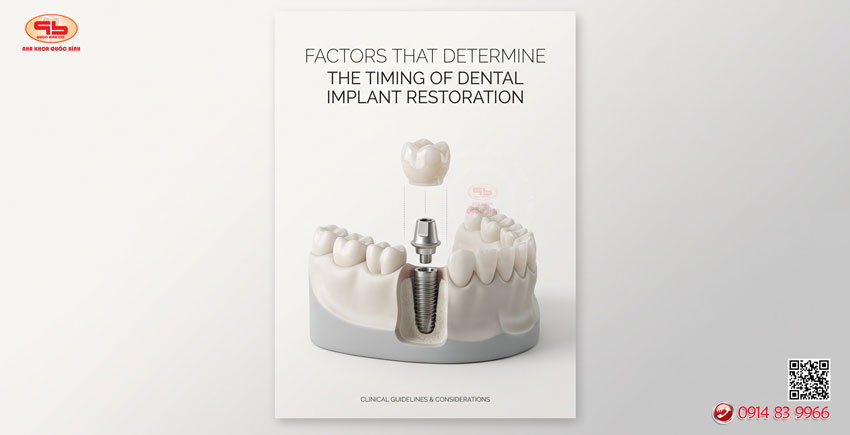
Factors That Determine the Timing of Dental Implant Restoration
After dental implant placement, many patients want to know when they can receive their permanent teeth.The timing of dental implant restoration depends on more than the number of days after surgery. Dentists must evaluate several factors related to the implant and surrounding jawbone. Implant stability, bone quality, and the overall treatment plan all play important roles.
Understanding these factors helps patients prepare for each stage of treatment.
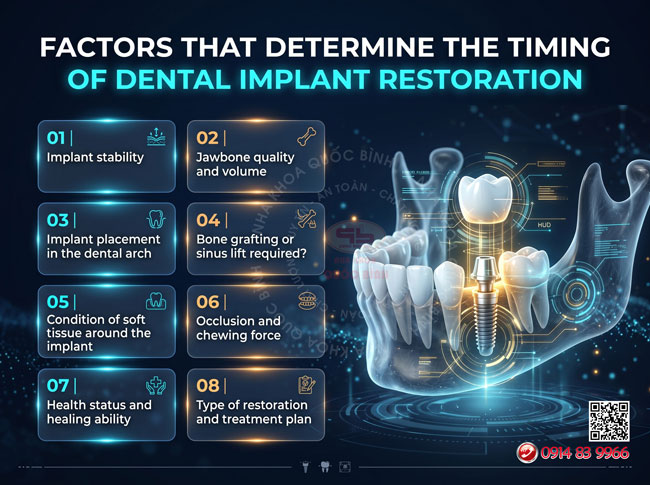
Dental Implant Stability
Implant stability is one of the most important factors in determining when restoration can begin. After placement, the implant must remain stable within the jawbone.Initial stability depends on the implant site and the quality of the surrounding bone.
Dentists may use clinical assessments and stability measurements to evaluate the implant. If the implant meets the appropriate criteria, early restoration may be considered.
If stability is insufficient, additional healing time may be necessary. The International Team for Implantology (ITI) identifies initial implant stability as an important consideration when selecting an early-loading protocol.
Therefore, restoration timing should not be determined by the calendar alone.
Jawbone Quality and Volume
The jawbone directly affects the support available for a dental implant. Adequate bone volume and density generally provide more favorable conditions for implant placement. Thin or insufficient bone may require additional treatment or a longer healing period.
Some patients need bone grafting before or during implant placement. In these cases, the dentist must evaluate healing in the grafted area.
Restoration timing may be adjusted to support predictable treatment outcomes. The need for bone augmentation is also an important consideration when selecting an implant-loading protocol.
As a result, two patients receiving the same implant system may have different restoration timelines.
Implant Position in the Jaw
The location of the missing tooth can influence the restoration plan.
Front teeth require particular attention to appearance, gum contours, and smile aesthetics. Back teeth must withstand substantial chewing forces. Dentists therefore consider the functional demands of each implant site.
Front-tooth restorations may require closer monitoring of the surrounding soft tissue. Back-tooth restorations may require greater attention to chewing forces and occlusal design.
Consequently, the same restoration timeline may not be appropriate for every implant position.
Does Bone Grafting or Sinus Augmentation Affect Timing?
Bone grafting can change the timeline for dental implant restoration. Patients with significant bone loss may need additional time for the grafted area to heal.
Sinus augmentation can also affect treatment progress in the upper back jaw. The dentist will consider the extent of the procedure and the patient’s healing response.
Some patients can receive implants at the same time as bone grafting. Others may need bone grafting first, followed by implant placement after healing.
When treatment requires multiple stages, the overall completion time may increase. More complex cases require an individualized decision about implant loading and restoration.
Soft Tissue Healing Around the Implant
The soft tissue surrounding an implant contributes to the final restorative outcome.
The gums need time to heal after implant surgery. In the aesthetic zone, the relationship between the gumline and the crown is particularly important.
If the soft tissue has not stabilized, the dentist may adjust the restoration schedule. This allows the dentist to assess gum contours and the appearance of the planned restoration. Careful evaluation is especially important for implants replacing visible front teeth.
Bite Alignment and Chewing Forces
Bite alignment affects the forces transferred to a dental implant. Patients with strong chewing forces may need additional consideration when planning restoration. Teeth grinding, also known as bruxism, can increase stress on implant restorations. Dentists evaluate the bite before deciding when and how to restore the implant.
A temporary crown may be designed to limit excessive forces when clinically appropriate. The goal is to protect the implant during the early healing phase.
Overall Health and Healing Capacity
A patient’s general health can influence the course of implant treatment. The dentist should assess factors that may affect healing before restoration.
Certain medical conditions or medications may require adjustments to the treatment plan. Periodontal health and oral hygiene also need careful evaluation.
Controlling inflammation helps create more favorable conditions for treatment. For these reasons, restoration timing should be individualized rather than based on a fixed schedule.
Type of Restoration and Treatment Planning
The planned restoration also influences the treatment timeline. A single implant crown requires a different approach from a restoration supported by multiple implants.
Full-arch implant restorations have additional functional and biomechanical considerations. Dentists should plan the restoration before implant placement whenever possible.
This helps guide implant positioning and the intended restorative design. A coordinated treatment plan also helps determine the appropriate loading protocol.
Why Should You Avoid Choosing Your Own Restoration Date?
Patients can have different bone conditions and soft tissue responses. Even two patients receiving implants on the same day may need different restoration timelines.
Additional healing time may be necessary to support implant stability. Other carefully selected cases may qualify for earlier restoration. Patients should not shorten or extend the recommended timeline without professional guidance. The final decision should follow a clinical examination and an assessment of implant healing.
Frequently Asked Questions
How Long After Dental Implant Placement Can You Get a Crown?
The timeline varies between patients. Some implants may qualify for early restoration when clinical conditions are suitable. Others require additional time for healing and osseointegration.
Does Good Bone Quality Mean I Can Get My Crown Sooner?
Not necessarily. Bone quality is only one factor in the decision. Dentists also consider implant stability, location, soft tissue, and bite forces. The overall treatment plan is equally important.
Does Bone Grafting Delay Dental Implant Restoration?
It can. The timeline depends on the extent of grafting and the healing response. Your dentist will recommend an appropriate schedule based on your clinical progress.
Can a Crown Be Placed Immediately After Implant Surgery?
Immediate restoration may be possible in carefully selected cases. However, specific clinical requirements must be met. The procedure should not be chosen solely to shorten treatment time.
Conclusion
The timing of dental implant restoration depends on several clinical factors. Implant stability and jawbone condition are particularly important. Implant position, soft tissue healing, and bite forces also influence the decision.
Bone grafting or sinus augmentation may extend the overall treatment timeline. General health and the planned restoration must also be considered. There is no single restoration schedule that suits every patient. A dentist should assess the implant and surrounding tissues before determining when the final crown can be placed.
This individualized approach helps balance treatment time with long-term stability and function.
—  —
QUOC BINH DENTAL CLINIC (formerly Vung Tau branch)
General Director – Dr. PHAN QUOC BINH
Location 1: 19 Pham Hong Thai, Tam Thang Ward, Ho Chi Minh City.
 0914 839 966 / (0254) 383 99 66
Location 2: 28 Le Loi, Vung Tau Ward, Ho Chi Minh City.
(0254) 381 83 18 / 0942 231 212
Location 3: 649 Truong Cong Dinh, Tam Thang Ward, Ho Chi Minh City.
Dentist in charge: Dr. NGUYEN HUU CHIEN
0708 649 649
Working hours: 7:30 AM – 11:30 AM, 2:00 PM – 8:30 PM
https://nhakhoaquocbinh.com/en/price-list/
https://www.facebook.com/nhakhoaquocbinh/
